‘Little Admirals’: Echoes of Masculinity, Nation and Empire in Public School Concerts in the First Half of the 20th Century
Emma Arthur (University of Oxford)
Introduction
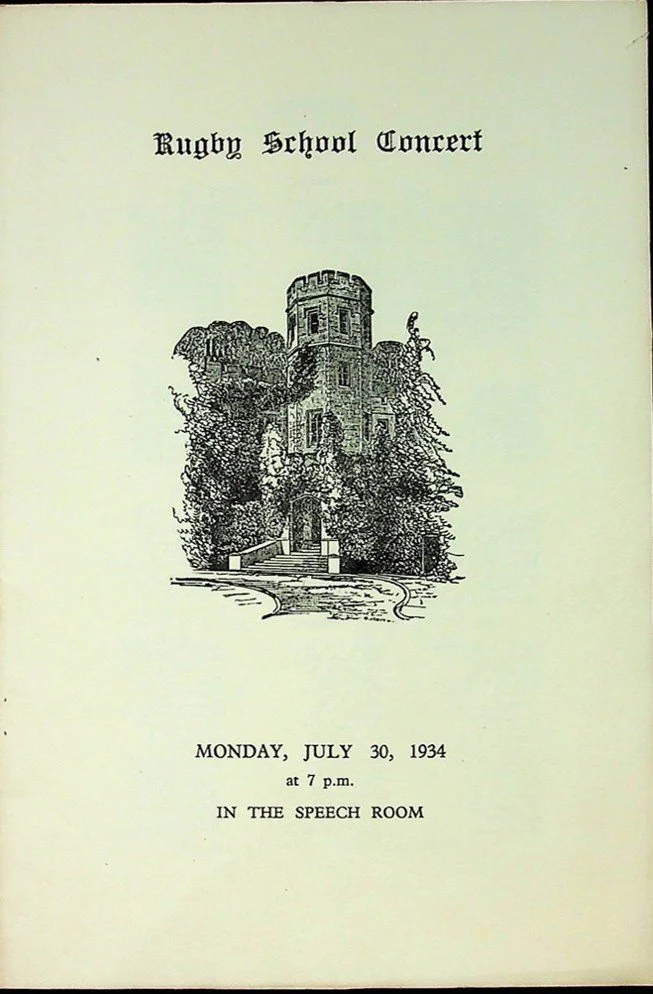
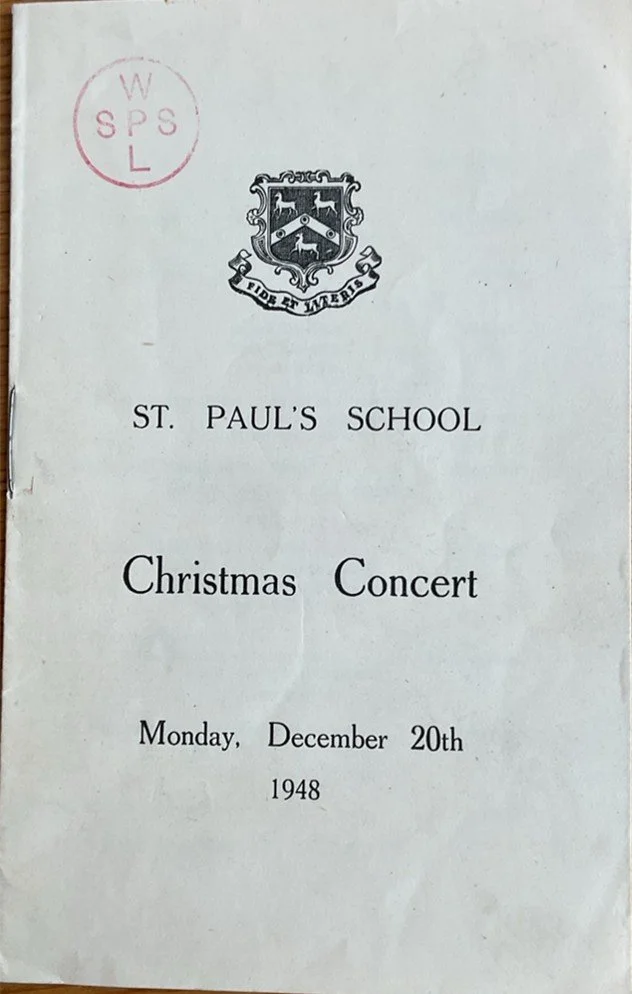
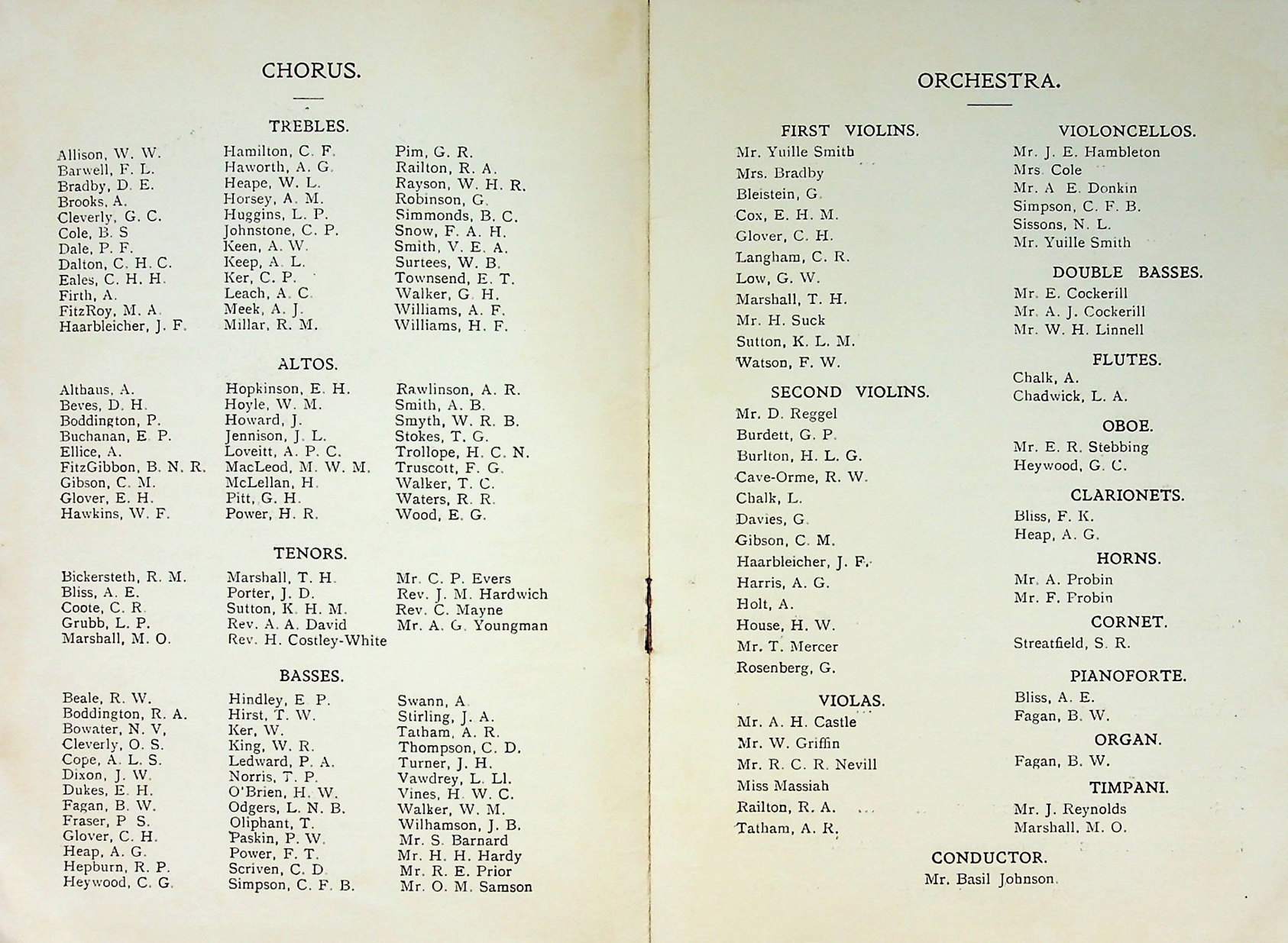
By the end of the nineteenth century, formal music education had become an established part of public school life (Rainbow, 1990). The musical culture at many public schools, including Rugby and St Paul’s School, London, had evolved by the last decades of the century to include annual school concerts as well as guest recitals from established professional performers. While Rugby put on at least one annual concert, typically in July of each academic year, St Paul’s normally held two, one in December and another in March or April. Students at both schools performed a varied repertoire of European Art Music from solo vocal and instrumental pieces to choral arrangements and orchestral works. Both schools boasted a large number of performers on these occasions, particularly in the choir, which would have included the vast majority of the student community.
Example of Concert Programmes from Rugby School (left) and St Paul’s School (right)
[Rugby School Archives & St Paul’s School Archives]
An example of the typical size of both Chorus and Orchestra at Rugby School (1929)
[Rugby School Archives]
Such musical instruction had been largely excluded by public schools for most of the nineteenth century, with the first attempts to implement formal music only emerging in the late 1850s (Tozer, p. 35). Although music had been accepted as part of the school’s Rifle Corps (which you can read more about here) and informal, student-led contexts like ‘Hall-Singing’ (read more here), prescribed music instruction was deemed by many headmasters of the early nineteenth century, most notably Rugby’s Thomas Arnold, as futile in a curriculum emphasising classics. In particular, Arnold believed that music was “particularly unwelcome in an institution where sturdy character-forming was rated high" (Rainbow, p.1),
While the widescale implementation of formal musical instruction in-and-around the 1860s marked a departure from this strict view of suitable ‘masculine’ education, it was far from a complete rejection of the established values of public school education. In fact, much of the music programmed echoed the school musical traditions of the previous century, with the military ballads introduced by school Rifle Corps and the sea-songs made popular through Hall-Singing continuing to hold a prominent role in the school repertoire. Ideals like duty, teamwork, leadership and patriotism, which had become so synonymous with the identity of the nineteenth-century schoolboy, were reinforced not only in this longstanding repertoire but in new works which depicted similar themes and narratives. Pieces like Edward Elgar’s cantata The Banner of St George (1897) performed by St Paul’s in 1927 exemplify how ideals of British nationalism continued to be reinforced in musical performances. Meanwhile, works like John Ireland’s In Praise of Neptune (1911), Edward Grieg’s Recognition of Land (1872) and the “Soldier’s Chorus” from Charles Gounod’s 1859 opera Faust, which were all performed in Rugby in the first half of the twentieth century, demonstrate the sustained prominence of bravery, leadership, militarism and imperialism. Colonial sentiments were also present, particularly in the performance of American colonial ballads such as Charles Wood’s setting of “Ethiopia Saluting the Colours” (1898), which was performed repeatedly at Rugby in the 1930s and 40s. While dispersed amongst a more diverse and advanced music repertoire, the presence of such motifs throughout school programming from the 1860s to the 1940s illustrates the continued existence of such ideology within public school culture.
A musical work that incorporated many of these ideals was Charles Villiers Stanford's 1910 song cycle Songs of the Fleet, which was performed by students at both Rugby and St Paul’s in 1929 and 1948, respectively. Through an examination of the themes present in Stanford’s song cycle, this short blog post hopes to highlight the retention and reinforcement of masculine and imperial ideals in the music performed by public schoolboys in the first half of the nineteenth century. As I will highlight here, the appearance of these songs in concert programmes demonstrates far more than an advancement of musical training in the twentieth-century public school. The narratives, theming and overall messaging of these works display an underlying continuation of the ideals of masculinity, Nation, and Empire which had come to dominate Public School life in the nineteenth century.
“Songs from the Fleet” (1910)
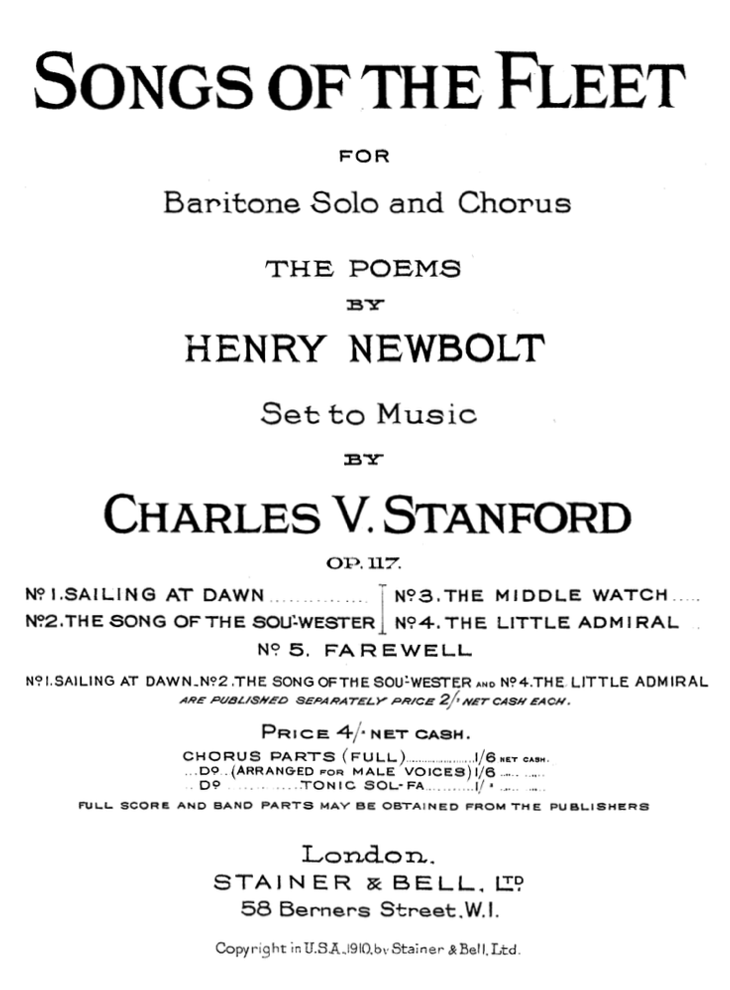
Cover of the Vocal Score of Songs of the Fleet (1910)
Stanford’s Songs of the Fleet comprises five songs for baritone, male vocal chorus and orchestra with words by poet Henry John Newbolt. While Rugby opted to perform the first two songs from the cycle, St Paul’s programmed it in its entirety. Based on the printed programme from 1929, it is likely that Rugby’s performance included much of the original scoring which called for significant orchestral accompaniment. St Paul’s on the other hand made do with a more modest production with just pianoforte and organ. According to a report of the concert published in The Pauline, “the soloist was Mr. A. N. G. Richards, who sang with a fine sense of the changing moods of the poems” while “the Choir sang very well in this, showing a good technical and rhythmic grip and a wide dual range varying from a full-blooded forte to a well-sustained pp in the accompanying sections” (The Pauline, No. 429, Feb 1949, pp. 41-42).
The programming of Songs of the Fleet was certainly a practical choice for both schools. The four-part chorus was ideally scored for a school choir comprised of boy sopranos and altos as well as more developed tenors and basses in the older years. While the baritone solo line carried significant musical and technical weight, the chorus comprised largely repetitive and catchy lines with a wide range of dynamics contributing to its overall effectiveness.
Setting Henry John Newbolt – Contextualising Stanford’s Song Cycles
In addition to these practical considerations, the song cycle was also firmly in line with the ideals of public school culture. Both Songs of the Fleet and its companion cycle Songs from the Sea (songs from which were also performed at Rugby in the 1920s) comprise settings of texts by the poet and novelist Sir Henry John Newbolt (1862-1938). While Newbolt published an extensive body of work during his career and even held a role as a government advisor for the study of English in England, he is arguably best known for poems like “Drake’s Drum” and “Vitaï Lampada”. The latter, written in 1892, describes how a schoolboy attending Clifton College (a prominent public school in Bristol and Newbolt’s alma mater) learns the importance of selflessness and duty through school cricket matches. Throughout the poem, Newbolt links athletic competition to sacrifices on the military battlefield where many students and similar schools would eventually find themselves. Such a view reflected the ‘cult of athleticism’ which had emerged in public school culture in the nineteenth century (See Mangan, pp. 124-129). The implementation of games in the public school, including the activities of the rifle corps, nurtured “a spirit of absolute obedience to the authorities” and a determination “to go on if we can till we drop dead”, both qualities demanded of an army officer (Sclater, cited by Adams, p. 47).
Such ideals of bravery and duty were certainly exhibited in Newbolt’s texts for both song cycles. As explained by Geoffrey Crankshaw, “Newbolt was particularly drawn to England's naval traditions and to the lure of the sea in general. His imagery was uncomplicated and his language bracing - just the right material for Stanford's down-to-earth honesty of vision” (1983). Newbolt’s loyalty to the British war effort (most notably through his involvement in the War Propaganda Bureau during the First World War) paired with Stanford’s staunch Unionism and British patriotism combined to form a body of work which reinforced a view of British naval life as moral, masculine and aspirational. Songs of the Fleet had been originally intended for the Jubilee Congress of Naval Architects in 1910, which was postponed due to the death of Edward VII (Blumhofer, 2018). Despite an alternative premiere at the Leeds Festival, the romantic depiction of life at sea remains prominent throughout the five songs.
Examining Meaning and Messaging in Songs of the Fleet
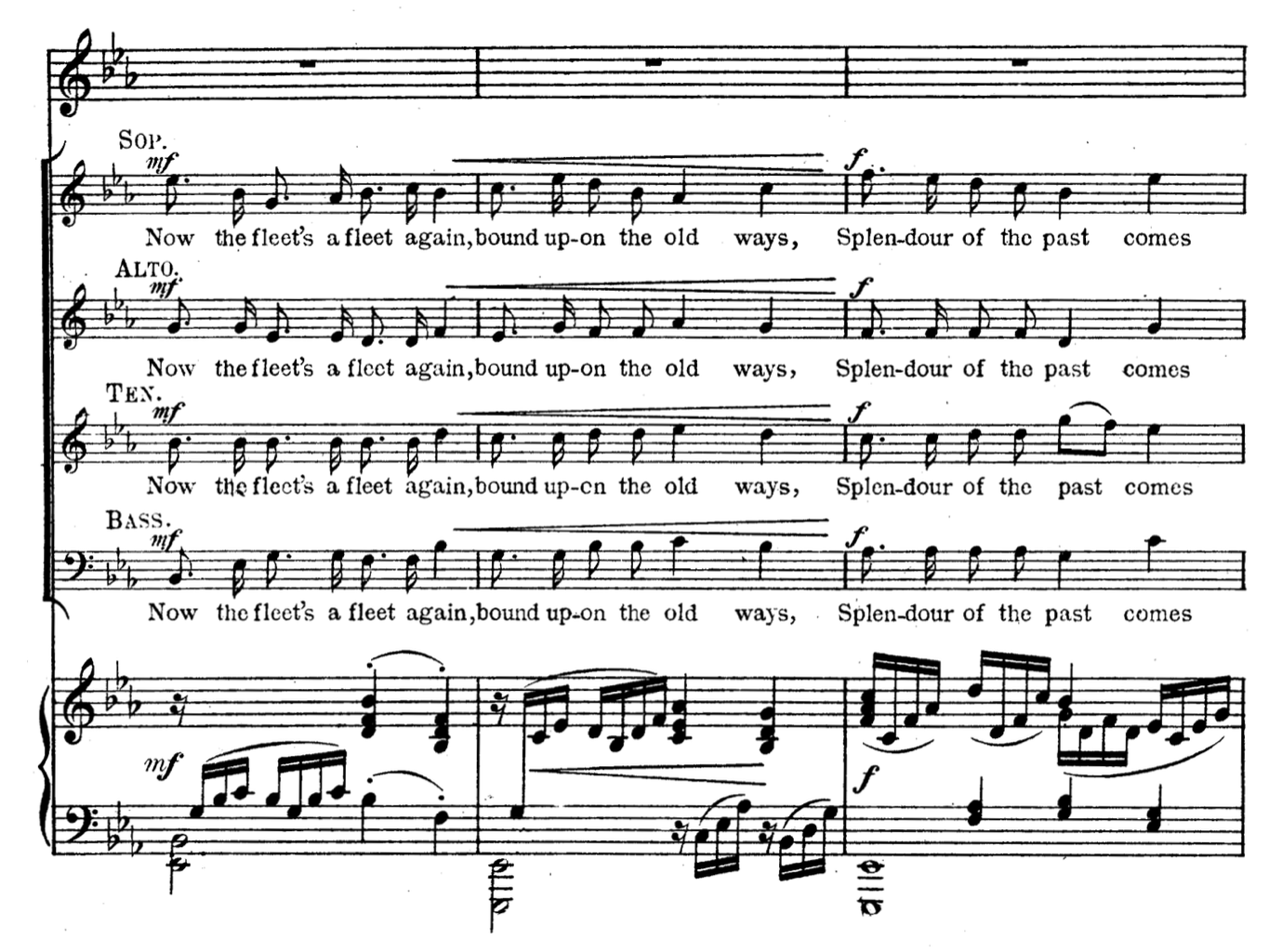
The opening song, “Sailing at Dawn”, depicts a large armada setting off from port at the break of day. In addition to evoking enthusiasm for the day ahead and loyalty to current and former leadership, the song celebrates the strength, duty and sacrifice of men leaving life on land to serve at sea:
Not for us the warm life of Earth, secure and tender,
Ours th’ethernal wandering and warfare of the sea
The verse-chorus structure of the song, with the chorus singing together in harmony, evokes a feeling of unified strength. In a similar way to the military ballads sung during drills and marches, engagement with these narratives and their depictions of strength, valour and athleticism, transformed schoolboys into the band of manly naval heroes described.
Songs of the Fleet (1910), p. 9
In “The Song of the Sou’wester”, the chorus takes on the voice of an aggressive storm which is depicted as a more terrifying prospect to any enemy ship. Stanford’s scoring demands a dramatic and boisterous performance from the singers as they evoke the violent forces of the wind:
Oh! I am the enemy most of might,
The other be who you please!
Gunner and guns may all be right.
Flags a-flying and armour tight.
But I am the fellow you’ve first to fight –
The giant that swings the seas!
While stories of dutiful men could be easily related to students’ relationships with their house, where responsibility and honour were regularly fostered through inter-house competitions, a boy’s powerful performance as an aggressive storm would have also communicated their embodiment of the prescribed ideals of masculinity to their peers.
The turbulence of “The Song of the Sou’wester” is followed by a dramatic change of mood in the third song, “The Middle Watch”. Depicting the calm after the storm, it depicts the peace and stillness of night in the middle of a calm sea, offering a romantic view of the beauty found during life at sea.
Like fleets along a cloudy shore
The constellations creep,
Like planets on the ocean floor
Our silent course we keep.
A lighter mood takes over for number four, “The Little Admiral”, a “ jaunty tribute to the enduring legacy of Horatio Nelson” (Blumhofer). Nelson was a Royal Navy officer who was credited with several notable British naval victories during the French Revolutionary and Napoleonic Wars. Most significantly, his death during the Battle of Trafalgar solidified his position as a public hero in Britain. The text of “The Little Admiral” unsurprisingly promotes ideals like bravery, loyalty, leadership and preparedness for battle:
Some day we’re bound to sight the enemy,
He’s coming, tho’ he hasn’t yet a name.
Keel to keel the gun to gun he’ll challenge us
To meet him at the Great Armada game.
None knows what may be the end of it,
But we’ll all give our bodies and our souls
To see the little Admiral a-playing him
A rubber of the old Long Bowls!
Such singing not only demonstrated the masculinity of students to the audience but also to their peers. As explained by Geoffrey Drage in 1890:
“English boys admire one who is brave. But it is physical courage which chiefly evokes their admiration. They hold that a young Englishman should do his duty gallantly, however unwelcome it may be, should bear pain unflinchingly, should volunteer for difficult and dangerous service, and should face the hardships of life with a smile" (Drage, as quoted by Griffiths, p. 60).
While it is difficult to know whether boys at Rugby or St Paul’s performed such music ‘with a smile’, the upbeat Allegro vivace (meaning “fast and lively”) would have certainly demanded an energetic performance full of lively spirit. These uplifting depictions of naval or military life exemplify how schoolboys were not only exposed to a particularly romanticised view of bravery and duty, but, in some cases, became desensitised to the more aggressive and violent realities of military or sailor life.
Finally, the sustained prominence of war commemoration throughout the first half of the twentieth century is exemplified in the fifth and final song. The suitably titled “Farewell” offers a memorial for the dead. Echoing the style and structure of Stanford’s sacred music, it features a hymn-like melody in the solo line with the choir providing a series of short refrains. While the song was incredibly popular during the First World War, its appearance in a concert programme in 1948 highlights the continuity and longstanding strength of such values as part of public schoolboy identity and culture after the Second World War. As expected, the lyrics evoke ideals of bravery, heroism and sacrifice, highlighting the continued importance of such imagery in public school culture throughout the nineteenth and twentieth centuries.
To keep the house unarmed
Their fathers built so fair,
Deeming endurance armed
Better than brute despair,
They found the secret of the word that saith
‘Service is sweet, for all true life is death’.
Commemoration of those lost in battle was a regular part of life for boys at school both in the 1920s and 40s. In Rugby in particular, commemoration of fallen Old Rugbeians formed a central part of chapel life. The memorial chapel at Rugby was completed in 1923 specifically “as a Memorial to the Rugbeians who fell in the Great War of 1914—1918” (Wilson). Once in every term that the war lasted, a memorial service was held in which all names were “called over” of those who had died since the last service. These acts of commemoration not only acknowledged the sacrifice of individuals but reinforced an idea of moral duty to military service and a connection between public school, chapel life and the British Military.
Towards a Conclusion
Although not all music performed in public schools in the twentieth century reinforced imperial themes, the continuation of such values within music programming, paired with the longstanding tradition of ending concerts with both the school song and national anthem, highlight a continuity of ideals relating to Masculinity, Nation and Empire which coloured student identity well into the middle of the twentieth century. In this light, musical practices like school concerts “were fundamental in preparing boys for imperial responsibility” (Rich, p. 25). As P. J. Rich has put it, “public school life was a rehearsal for [the] Imperial show" (Rich, 1989). While the musical traditions of public schools evolved significantly between 1850 and 1950, the primary image of masculinity promoted and reinforced through student music-making remained closely bound with romantic ideals of service and sacrifice nested in a distinctly British Imperial context.[2420]
_________________________
Score referenced
Stanford, Charles V., Songs of the Fleet, Stainer & Bell. LTD, 1910 [Musical Score, Vocal Score]
Recording (with score)
https://www.youtube.com/watch?v=s32pbej-Bog&list=RDs32pbej-Bog&start_radio=1
_________________________
Bibliography
The Pauline No. 429, Feb 1949 (St Paul’s School Online Archive)
Adams, Claire Louise Frances. ‘Duty, Imperialism and Militarism in the British Public School 1850-1918’. Durham University, 2017.
Blumhofer, Jonathan. ‘Rethinking the Repertoire #24: Charles Villiers Stanford’s “Songs of the Fleet”’. The Arts Fuse, 2018, https://artsfuse.org/171162/rethinking-the-repertoire-24-charles-villiers-stanfords-songs-of-the-fleet/
Crankshaw, Geoffrey. Liner notes to Stanford*, Benjamin Luxon, Bournemouth Symphony Chorus, Bournemouth Symphony Orchestra, Norman Del Mar – Songs Of The Sea / Songs Of The Fleet, EMI Records ASD 4401 (1983)
Griffiths, John. ‘The Training of an English Gentleman in the Public Schools 1’. In Empire and Popular Culture, 1st ed. Routledge, 2021.
Mangan, J. A., ‘“Muscular, Militaristic and Manly”: The British Middle-Class Hero as Moral Messenger’, The International Journal of the History of Sport 13, no. 1 (2007)
Melly, George. School Experiences of a Fag at a Private and Public School. Smith, Elder, and Co., 1854.
Rainbow, Bernarr. Music and the English Public School. Boethius, 1990.
Rich, P. J. Elixir of Empire: The English Public Schools, Ritualism, Freemasonry, and Imperialism. Regency Press, 1989.
Tozer, Malcolm. From Prussia with Love: Music at Uppingham School, 1853-1908. Journal of Historical Research in Music Education, vol. 41, no. 2 (2018): 105–31.
Wilson, W. N. Rugby School Memorial Chapel. George Over, Limited, 1923. Rugby, n.d.