“Let our voices the praises proclaim of our soldierly, brave Rifle Corps!”
Examining the Musical Identities of The Rugby School Rifle Corps (c. 1860-1945)
Emma Arthur (University of Oxford)
Introduction
In 1859, Secretary of State for War Jonathan Peel sent out a circular letter to public schools and universities across Britain inviting them to form units of the Volunteer Corps. Sparked by increasing fears of French invasion in the 1850s, the newly formed Volunteer Corps, made up of regiments in towns, public schools and universities, was intended to stand as the country’s last line of defence. Training included musketry practice, combat training, in addition to drills, encampments and other exercises. The new volunteer corps additionally became closely intertwined with the development of British martial music in communities across the country. As argued by Trevor Herbert and Helen Barlow, the volunteer movement became “an important element in the very existence of the brass band movement" (Herbert and Barlow, p. 166). Corps based at public schools were commanded and officered by school masters, with the assistance of ‘sergeants’ who joined schools after leaving the army. Many of these men were part of the “first generation of competent and literate military musicians” in Britain and implemented their musical training into their new roles in amateur corps post-military service (Harris, p. 1).
The musical practices of the Rugby School Rifle Corps (also referred to as the O.T.C and later the C.C.F) not only exemplify this prominence of martial music in volunteer rifle corps but also highlight the role of the corps in the formation of school, national and imperial identities amongst students. As I aim to show briefly here, through the singing of songs and the playing of band music, students at Rugby communicated their school pride, their British patriotism, and their position within the Empire.
A Brief History of the Rugby School Rifle Corps and its Music
On 9 May 1860, Dr Temple announced the formation of the Rugby School Rifle Corps. Like those of the other public schools, the school’s rifle corps was connected to the volunteer corps of the local town, sharing the title of '3rd Battalion Warwickshire Rifle Volunteers' (or, the 3rd Warwickshire Corps). Reports in The Meteor detail the regularity of rifle corps activities at Rugby School, which comprised weekly drills and exercises as well as shooting competitions, field days (or ‘march outs’) and camps between school houses and the rival corps of other public schools, universities and town volunteer corps.
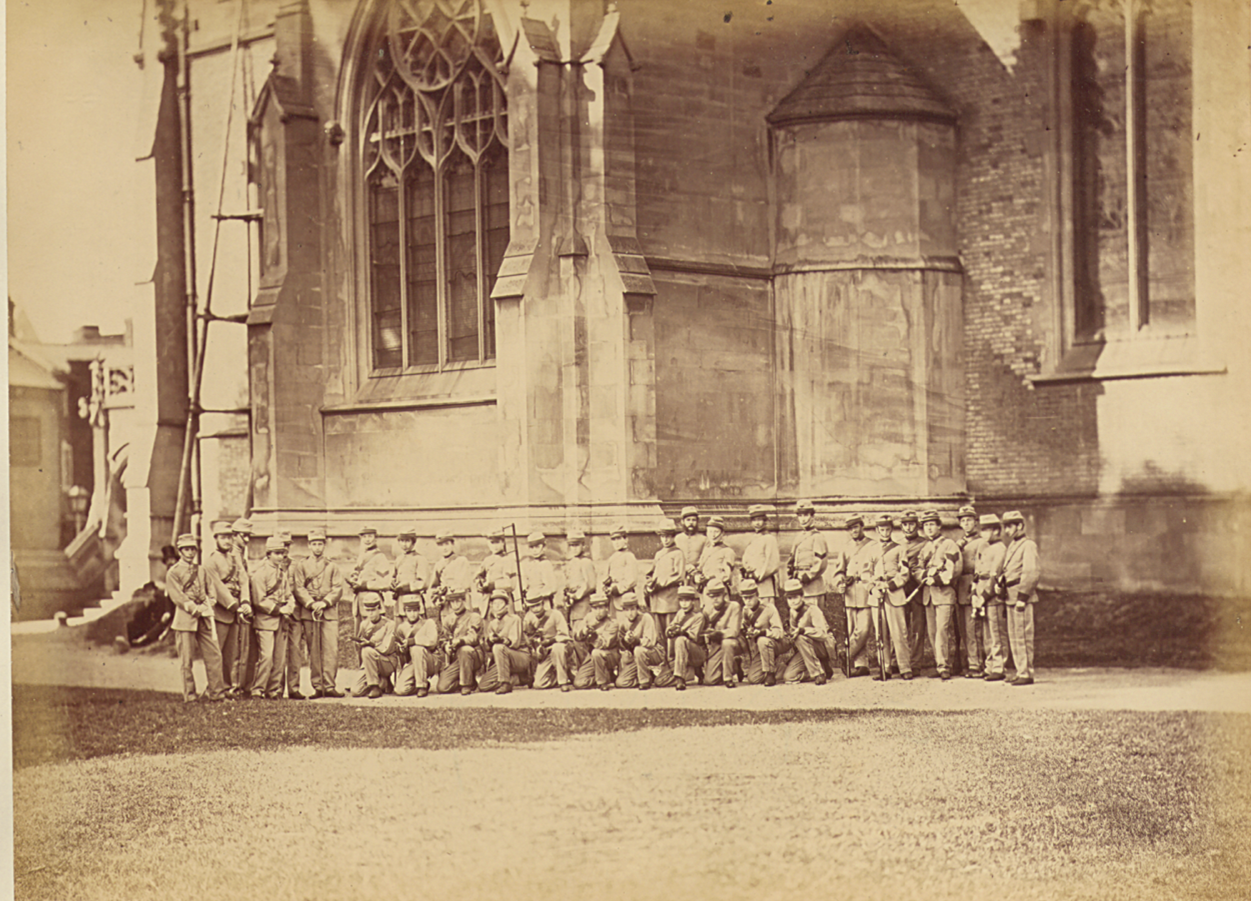
‘School Chapel – with Rifle Corps 1858-1862’ in Rugby Photos 1860-1970 [Rugby School Archives]
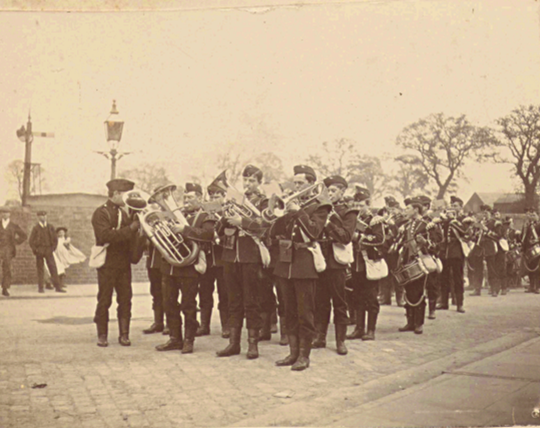
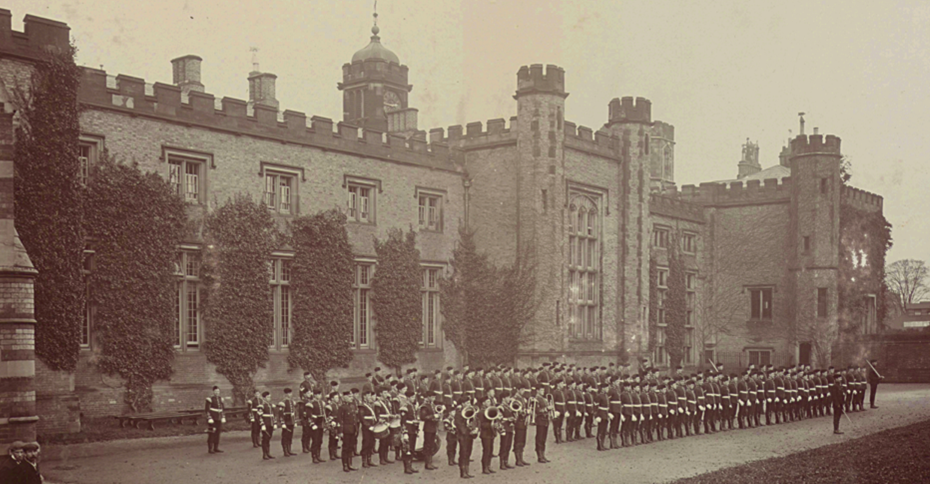
After some early attempts at forming a band from around 1891, The R.S.R.C.V.C Drum and Fife Band officially came into existence in 1894, followed by the Brass Band, which made its first public appearance in 1897. Like the bands that accompanied units in the British military, Rugby’s band fulfilled three main musical functions: they supported marches and parades, played at camps for officers and cadets, and performed concert music both at school and in the town. Although activities were limited during the First and Second World Wars, the band continued to perform at the annual school concert, performing a range of popular genres while retaining a distinct martial flavour.
‘The Band’, Rugby Photo Album, (1902) [Rugby School Archives]
The late establishment of a band did not reflect a lack of musical activity at Rugby during its earlier decades, however. Marching songs were undoubtedly part of the corps’ activities from the very beginning, particularly during marches and field days. Singing remained an important part of rifle corps culture well into the 20th century. From around 1909, the so-called ‘sing-song tent’ emerged as a hive of musical activity at camps, bringing together boys on all sides for evenings of singing and drama.
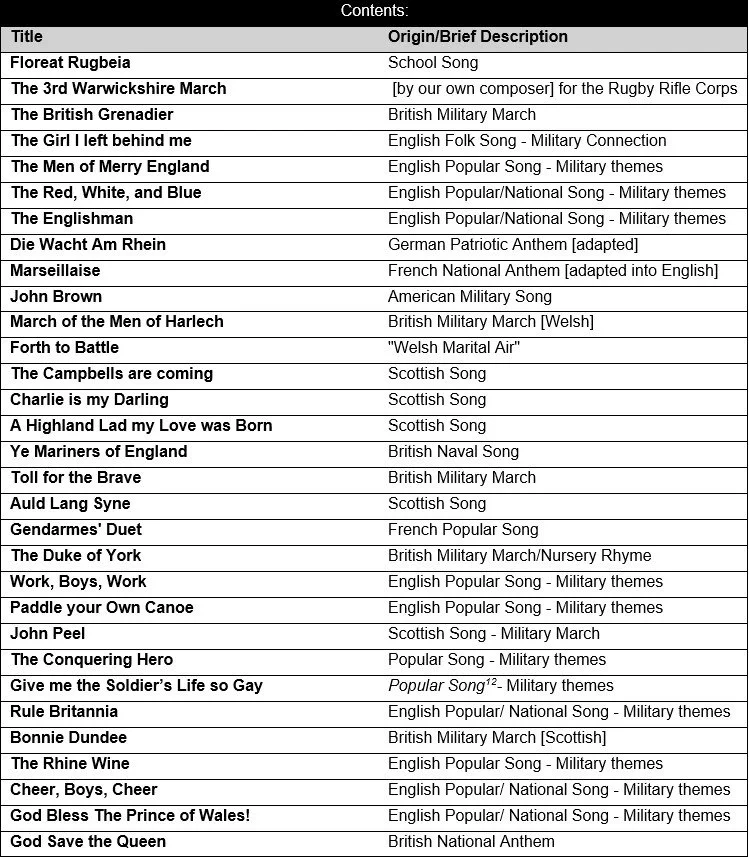
The Songbook of the Rugby School Rifle Corps (1873)
The earliest evidence of the corps’ singing tradition appears in the form of a songbook printed by W. J. Tait and Sons in 1873. The pamphlet-sized book appears to have been commissioned as a fundraising activity and sold to current and former members. Details of the money raised by the sale of songbooks were included in the accounts of the Rifle Corps published in The Meteor in 1873 and 1875. The printed collection comprises 31 songs, including the national and school anthem as well as various folk and popular songs with military themes. In addition to a large number of British pieces (including those of Scottish and Welsh origins), the collection also features songs from France, Germany and the United States of America.
Such a repertoire stands very much in line with trends in military music during this period. In addition to their suitability for marching (ensured through melodic simplicity, steady rhythm and catchy lyrics), songs were also typically adopted due to their popularity among members of the regiment. This often included ballads composed for the published music market, reflecting the interconnected relationship between military music and the nineteenth-century recital hall. Several of the tunes featured in the Rugby songbook, including “The British Grenadiers”, “Rule Britannia” and “The Men of Harlech” were staples of British military music in the nineteenth century, highlighting the trickle-down of repertoire to the volunteer regiments.
While the selection of many of these songs may seem unremarkable given their obvious connections to military activity, their curation offers us deeper insights into the ideals and identities performed by a public school rifle corps. The musical practice of The Rugby School Rifle Corps highlights how public school students perceived themselves as linked to the wider British military (and imperial) project. The organisation of the 1873 songbook exemplifies the layered identity of the public school student. The placing of two songs specifically connected to Rugby School at the beginning of the book, followed by songs associated with the British nation and military, and concluding with the national anthem, highlights the interconnected relationship between school, nation and empire at the centre of public school experience during this period. A staple of everyday life in Rugby, the pairing of the “Floreat Rugbeia” with “God Save the Queen/King” presented loyalty to school and nation as inextricably linked. Even as the band began to perform a more expansive concert repertoire in the twentieth century, the two anthems continued to hold a prominent role in musical proceedings. Such a perception of British public school identity can be likewise traced through the rest of the rifle corps’ song repertoire.
School Pride and the Shaping of the Ideal Schoolboy
Songs have been sung of our Founder's great fame,
And the deeds of Rugbeians of yore,
Songs praising Football, our noble old game,
And our Cricket's been sung of before,
Now let our voices the praises proclaim,
Of our soldierly, brave Rifle Corps!.
(“The Rifle Corps”, quoted in Harris, pp. 48-49)
As shown in the opening verse of “The Rifle Corps”, sung by Rugbeians in the 1890s, the school corps was viewed by students, like any other school sport, as a vehicle for exhibiting school pride. The local patriotism of espirit de corps was central to public school life. In a world where school and house pride were paramount, such ideals were naturally extended to the school corps. Students asserted school and house pride through drill competitions held between houses, as well as days spent competing against rival corps in neighbouring communities. “Floreat Rugbeia” and Rugbeian-composed songs were commonly performed together on the sidelines. Such is exemplified by " The 3rd Warwickshire March” in the 1873 songbook. Adapted by the corps’ “own composer”, the march refers to several memorable events in the recent memory of the corps. For example, the line, “The porters at Brandon got us all in a mess: But he wouldn’t be done, for he stopped the express”, references a humorous incident from a “March out” in 1873, after which the students were left stranded at the train station. The incident was reported in detail in the March issue of The Meteor.
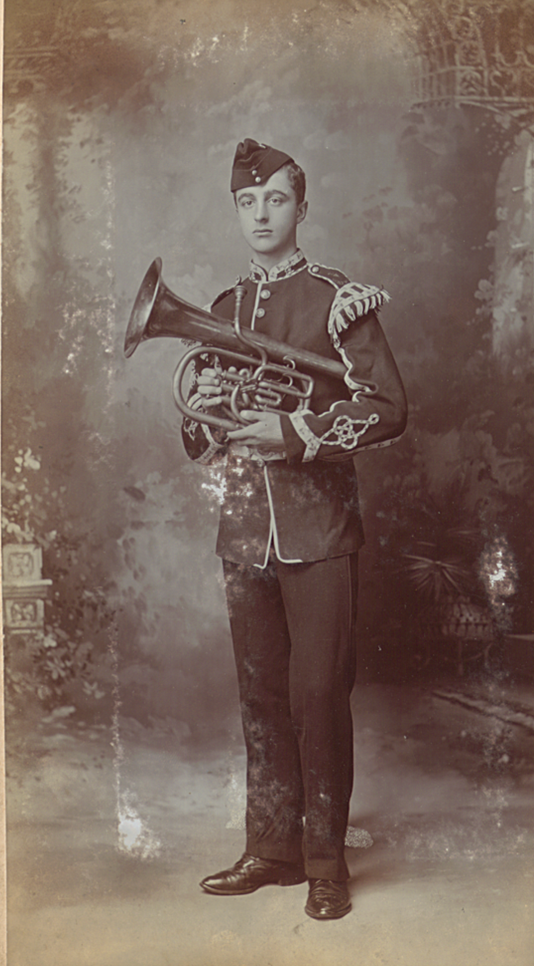
Through the composition of a custom ‘theme tune’ or the adoption of a pre-existing song, rifle corps reinforced regiment identity. While the inclusion of memories and inside jokes contributed to a sense of camaraderie, references to the bravery and success of the corps projected an image of strength to both rivals and onlookers. The Band’s role in presenting military strength is exemplified in their visual presentation. In addition to their scarlet band uniform, the band members were adorned with leopard skins and other accessories gifted by Old Rugbeians. As P. J. Rich has put it, “public school life was a rehearsal for [the] Imperial show". This was no better highlighted in the performance of the band at ‘march outs’ and other important school events, which offered students “a tutoring in how to stage Imperial gaudies”.
‘One of the School Band’, Rugby Photo Album, (1902) [Rugby School Archives]
‘Rugby School Volunteer Corps and Band’, Rugby Photo Album, (1902) [Rugby School Archives]
Through their promotion of school and house loyalty on these occasions, Rugby students formed part of a strong group identity. As a result of their rifle and musical training, they learned how to both work and view themselves as a collective, values which were central to military life. Moreover, the hierarchical structure of the rifle corps, in which older boys trained younger cadets, equipped Rugbeians with familiarity in both giving and receiving orders, skills which were useful for futures in the military or other roles within the empire. Closely linked to these ideals of duty and obedience was an emphasis on bravery and toughness. The pride attached to harsh training is reflected in another verse of “The Rifle Corps”:
'Citizen's plain' some will be without doubt,
They will never regret they bore
Drills by the dozen, and long 'marches out',
Whence they came home both tired and footsore;
So with a good will let out and all shout!
'Here's long life to our brave Rifle Corps!"
(“The Rifle Corps”, quoted in Harris, pp. 48-49)
Strength, bravery and endurance likewise ring throughout the rifle corps 1873 songbook. Through their performance of such songs during marches and drills, cadets were not only supporting the rhythm of the march but, more importantly, absorbing an understanding of expectations placed on them by their peers, their corps leaders and their school. Their confident and energetic assertion of songs like “Forth to Battle” enabled boys to present themselves as the proud Rugbeians they were expected to be:
“Strike the Harp! Awake the cry!
Valour’s sons fear not to die.”
(“Forth to the Battle”, 1873 Songbook, p. 11)
The emphasis placed on duty and endurance exhibited in marching songs of this period reflects the growing ‘cult of athleticism’ which had emerged in the nineteenth century. The implementation of games in the public school, including the activities of the rifle corps, nurtured “a spirit of absolute obedience to the authorities” and a determination “to go on if we can till we drop dead”, both qualities demanded of an army officer. While the singing of such songs may appear trivial, their performance by students within the context of the public school rifle corps both reinforced and reflected the preparation of public schoolboys for their future imperial responsibilities.
“Give me the Soldier’s Life so Gay”: Romanticising Military Life
The ‘aura of heroism’ which engrossed public school culture in the late nineteenth and early twentieth centuries resulted in many students engaging with a romanticised image of war and military life. Songs in the 1873 collection, including “The Conquering Hero” and “Give Me The Soldier’s Life So Gay”, exemplify the idyllic picture of war commonly held by public school students.
The singing of such songs, particularly during the playing out of “battles” against rival volunteer corps, solidified a view of military life as thrilling and empowering. Through their engagement with these games, which celebrated sportsmanship and athleticism, schoolboys were transformed into “imperial heroes”. Field days, camps and ‘marches out’ were routinely reported by The Meteor in a similar way to real-life conflict, indicating the absorption of this perspective by students. Both the practical and cultural training offered by the school rifle corps equipped many Rugby graduates with the skills and confidence to pursue military careers. As exerted in “The Rugby Corps”:
Some may in future the sabre wear,
Or perchance they may wield the claymore,
Glory to Rugby! They'll all add their share,
As the brave fifty-three did before,
Where'er they be, they will score to despair,
Since they've marched in our tough Rifle Corps
(“The Rifle Corps”, quoted in Harris, pp. 48-49)
Exhibiting National Patriotism and British Loyalty
The romantic image of military life constructed in the public school was distinctly a British one. As shown in the contexts of Rugby’s 1873 songbook, marching songs adopted by school rifle corps regularly emphasised British identity and military superiority. Such repertoire closely reflects the intention behind Peel’s volunteer movement, which sought to rebuild the British military both in numbers and in reputation. While all marching songs would have been sung and heard with the British military in mind (even those of French and German origin were adapted for the British context), several songs in the 1873 collection, including “The Men of Merry England”, “The Red, White, and Blue”, “The Englishman” and “God Save the Prince of Whales” exhibit strong British (and particularly English) patriotic sentiments.
“Its honour is stainless, deny it who can,
The flag of a true-born Englishman”
(“The Englishman”, in The Songbook of the Rugby School Rifle Corps,1873)
In addition to reflecting the British patriotism which had become central to public school culture, the musical activities of the school rifle corps became a key part of the cultural nationalism of British military music during this period. In a similar way to their role in uplifting soldiers during military expeditions, the bands of volunteer corps, like that of Rugby, offered comfort and security to the school and local community during periods of unrest. Even within the context of a public school recital hall, martial music “helped the military in its role of maintaining public order by conveying the idea of strength and military coherence" (Harris, p. 158). Such can be seen in their performances during the Second World War. As described by Harris, “at no time were they more popular than in 1940, when the gun flashes and noise of the bombs dropping on Coventry were forgotten for an hour in the 'blackened out' Speech Room" (Harris, p. 158).
Imperial Considerations - Sounding “Imperial Manliness”
The popularity of militarism was by no means unique to the public school. In fact, by the turn of the century, “everyone in Britain [..] appeared to be interested in war” (Mangan, p. 127). The establishment of rifle corps in public schools coincided with the emergence of a “new imperialism” in which “the English were continually exhorted to be patriotic” (Mangan, p. 128). In addition to a growing dominance of cultural nationalism (as illustrated by the establishment of the rifle volunteers and the attached musical tradition), British patriotism became “increasingly characterised by a belief in the morality of imperialism” (Mangan, p. 128). Themes of destiny, duty, and service became closely intertwined with imperial ideology, a creed which also incorporated militaristic overtones. As the marching songs of Rugby’s rifle corps have shown, the public schoolboy was carefully moulded to serve this mission. The promotion of school pride, British patriotism, and new militarism all combined to form an ideal of ‘imperial manliness’ which prepared the public schoolboy for his role within the Empire.
Towards a Conclusion
“[It] was a medium as much as a mirror. It promoted as much as reflected imperial involvement. It developed an awareness of an imperial responsibility. And it was a responsibility boys accepted. It excited their imagination; and offered them instruction in a faith that was at one and the same time reassuring and stimulating" (Mangan, p. 136).
J. A Mangan’s discussion of popular literature for boys during this period, quoted above, not only encapsulates the cultural function of martial music in the public school but also highlights the wider experience of the public schoolboy in the late nineteenth and early twentieth centuries. Music was far from the only cultural tool shaping students for their imperial future. However, as I hope to shown here, the musical repertoire and practices implemented in schools like Rugby, particularly those connected to the school’s rifle corps, offer us a useful insight into the ideas and perceptions which characterised public school identity and experience.
Although this discussion has been limited to the music of Rugby’s rifle corps, the ideals of militarism, imperialism, and masculinity performed in school military music can be seen to echo across various other musical traditions, from house singing (or ‘shouting’), musical commemoration in chapel, to concert repertoire. In all cases, the musicking of public students sounded both the ideals of the institution and the expectations understood and accepted by the schoolboy.
Let each in the wide world, whoever has been
One of those who that uniform wore,
Serve with whole heart his nation, his country, his Queen,
And wish luck to our brave Rifle Corps.
(“The Rifle Corps”, quoted in Harris, pp. 48-49)
Bibliography
Adams, Claire Louise Frances. ‘Duty, Imperialism and Militarism in the British Public School 1850-1918’. Durham University, 2017.
Harris, H. J. A History of the First Hundred Years of the Rugby School Corps 1860-1960. Brown Knight & Truscott, 1962.
Herbert, Trevor, with Helen Barlow, Music and the British Military in the Long Nineteenth Century. Oxford University Press, 2013
Mangan, J. A., ‘Duty unto Death: English Masculinity and Militarism in the Age of the New Imperialism’, The International Journal of the History of Sport 27, nos. 1–2 (2010): 124–49.
Mangan, J. A., ‘“Muscular, Militaristic and Manly”: The British Middle-Class Hero as Moral Messenger’, The International Journal of the History of Sport 13, no. 1 (2007): 28–47.
Rich, P. J. Elixir of Empire: The English Public Schools, Ritualism, Freemasonry, and Imperialism. Regency Press, 1989.