Musical Manliness: An Examination of the Repertoire and Rituals of ‘Hall-Singing’ at Rugby School
Emma Arthur (University of Oxford)
Introduction
The appointment of Thomas Arnold (1795-1842) as headmaster of Rugby School in 1828 marked the start of a new era for the English Public School. His reforms to both the curriculum and governing structure of Rugby came to redefine public school education and the traits expected of the ideal public school boy. Arnold’s curriculum, which placed heavy emphasis on classics, made little room for the arts, including music. To quote Bernarr Rainbow, “music meant nothing to Arnold; and he did nothing to promote it” (Rainbow, p. 28). This exclusion of music education was common across public schools in the early nineteenth century, with the first attempts to implement formal music only emerging in the late 1850s (Tozer, p. 35). The public school was, however, far from an unmusical place in the early nineteenth century. At Rugby, as in several other public schools, a tradition of group singing in boarding houses played a prominent role in the school's social calendar. Moreover, despite Arnold’s belief that music was “particularly unwelcome in an institution where sturdy character-forming was rated high" (Rainbow, p.1), the musical practices of students at Rugby highlight a deep absorption of the ‘masculine’ characteristics promoted by their headmaster. As I hope to show briefly here, the repertoire and ritual associated with the Rugbeian practice of ‘Hall-Singing’ were underpinned by principles of leadership, endurance, bravery, and heroism, all of which helped to shape schoolboys into imperial leaders.
Public School Boyhood and the Pursuit of ‘Manliness’
Public school education in the nineteenth century was characterised by an all-consuming need to define and promote ideals of manhood and masculinity. During their time at school, boys were expected to develop several characteristics necessary to become ‘real men’. “These included personal endurance, self-reliance, an unquestioned devotion to ‘duty', and the ability to administer justice or punishment." (Neddam, pp. 304-305). At Rugby, in addition to promoting these traits through the classroom curriculum, this pursuit of ‘moral manliness’ was instilled in students through a formal prefect system which assigned senior students roles in the school's governance, particularly in managing and disciplining younger boys. Arnold’s adaptation of the prefect system and its promotion of independence, responsibility and self-determination amongst students quickly became synonymous with public school education. His implementation of the hierarchical structure was based on the belief that “it was right for a boy who was destined to lead to learn first to obey a worthy authority" (Nash, p. 17). Once a student had completed a year of taking orders from older students, he could then begin to take responsibility himself. This ‘chivalric model’, allowed students to imagine “relationships between men and how they might perform tasks for each other in knightly service—a brotherhood within an elite—without compromising social standing”( Hamlett, p. 95). Even in his carrying out of seemingly domestic duties like cleaning, a boy’s duties took on “a specifically masculine form of domesticity that was often framed and valorized through the ideals of chivalric masculinity” (Hamlett, p. 82). Whether giving or receiving orders, a student’s responsibilities were subsequently understood as a performance of duty both to his house and school.
This hierarchical structure and the ‘manly’ traits it intended to foster extended into all aspects of public-school life, including the unsupervised activities of students in their free time. Their prominence in student-led rituals like ‘Hall-Singing’ highlights the extent to which these ideals were absorbed, accepted, and reinforced by the boys themselves.
‘Hall-Singing’ at Rugby: A Brief Overview
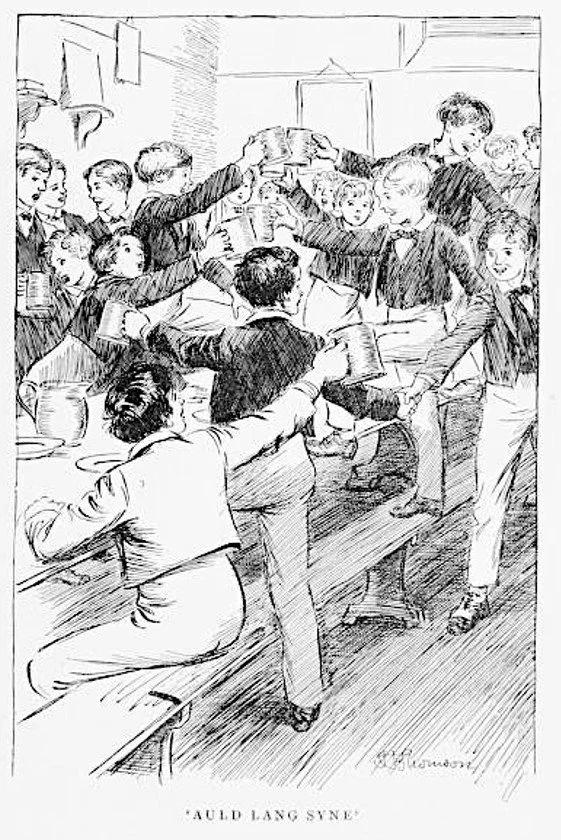
The ritual of ‘Hall-Singing’ was well established at Rugby by the time of Arnold’s appointment in 1828. Not to be confused with the practice of ‘House Singing’ or ‘House-Shout’ first introduced by John Farmer at Harrow in the middle of the century, the custom of singing in Hall was entirely a student-led tradition. As the name suggests, the tradition involved the boys gathering in the hall of their boarding house after dinner and singing until bedtime (Bloxam, p. 11). The decision to schedule the event on the last few Saturdays of each half-term seems to have been a practical one, as explained in Thomas Hughes’ novel Tom Brown’s School-Days, there was “no first lesson to do [...] and [a] lie in bed tomorrow morning” (Hughes, p. 132).The double allowance of beer provided on Saturdays was saved for the occasion, which, combined with a lack of adult supervision, contributed to a generally boisterous environment:
“The glasses and mugs are filled, and then the fugleman strikes up the old sea-song, "A wet sheet and a flowing sea, And a wind that follows fast," etc. and all the seventy voices join in, not mindful of harmony, but bent on noise, which they attain decidedly, but the general effect isn't bad” (Hughes, p. 136).
Thomas Hughes, Tom Brown’s School-Days, by an Old Boy. Edited, with a Preface, by H. C. Bradby, B.A. With Illustrations in Color and Pen and Ink Sketches by High Thomson (LeRoy Phillips, 1920), Internet Archive, p. 146. https://archive.org/details/tombrownsschoold00hugh/page/n5/mode/2up.
As Thomas Hughes’ description of hall-singing highlights, musical quality was far from the main object of these evenings. To quote Bernarr Rainbow, “the musical significance of those roistering sing-songs was minimal [..] its purpose was to strengthen the social bond” (Rainbow, p. 28). Through these habitual musical gatherings, boys reinforced their house identity. Their singing of songs in unison created a sense of cultural unity, echoing the shouting of chants on the sports sidelines or the singing of the school song at assembly. The fostering of camaraderie amongst students, particularly within boarding houses, was not only central to the system of governance at Rugby but also reinforced the importance of duty, which was so central to the ideal of ‘manliness’ promoted by public school education. By inspiring pride, loyalty and the esprit de corps for their house and school, boys were taught to “look upon themselves as answerable for the character of the school, and by the natural effect of their position acquire a manliness of mind” (as quoted by Ellis, p. 41).
The New Boy Solo and the Performance of Manliness
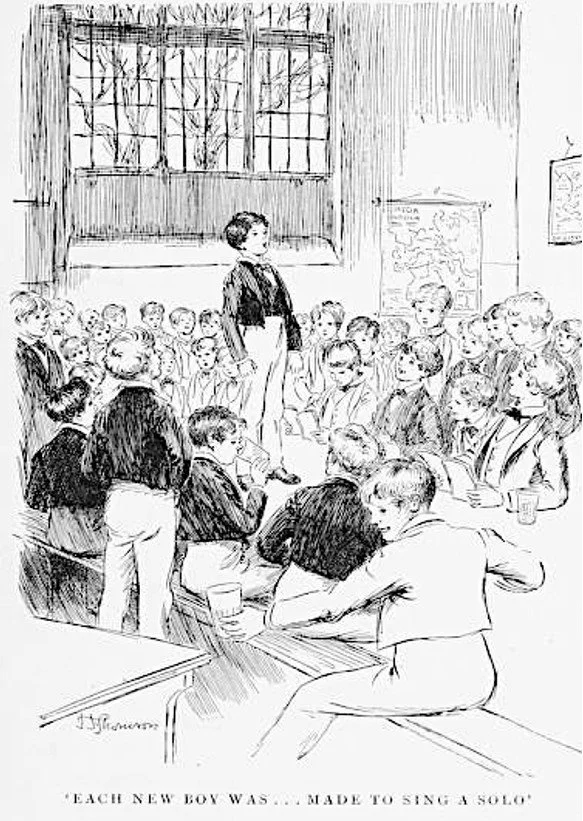
Duty to one’s house and school was emphasised from the very beginning of a boy’s time at school. As argued by Arnold, “‘as long as a boy remains at school […] the respectability and immunities of manhood must be earned by manly conduct and a manly sense of duty” (Ellis, p. 45). In Rugby, as in several other public schools during this period, hall-singing formed a key part of a boy’s initiation into his boarding house. On the night of their first singing session, each new boy was expected to perform a solo song, which was often pre-selected by the house. As described in Tom Brown’s School-Days:
"Each new boy was placed on the table in turn, and made to sing a solo, under the penalty of drinking a large mug of salt and water if he resisted or broke down. However, the new boys all sing like nightingales to-night, and the salt water is not in requisition—Tom, as his part, performing the old west-country song of "The Leather Bottel" with considerable applause” (Hughes, p. 134).
Thomas Hughes, Tom Brown’s School-Days, by an Old Boy. Edited, with a Preface, by H. C. Bradby, B.A. With Illustrations in Color and Pen and Ink Sketches by High Thomson (LeRoy Phillips, 1920), Internet Archive, p. 135. https://archive.org/details/tombrownsschoold00hugh/page/n5/mode/2up.
While Tom’s solo ended in applause, not all new boys received as warm a welcome. Many accounts of hall-singing by former public school students emphasise the difficulties faced by new boys in performing their mandatory solo. As M.H. Bloxam describes in his Personal Reminiscences of Rugby School as It Was in 1813, “the vocal music was somewhat discordant” (p. 11). For the rest of the house, their lack of vocal skill was often the event’s key attraction. Discussing the same tradition at Harrow, John Ivimey recalled how frequent difficulties in tuning were often “much to the delight of the house” (Ivimey reproduced by Rainbow, p. 275).
Although both Hughes and Ivimey describe the penalty of saltwater as a sort of empty threat, there is significant evidence to suggest that audiences were not always so charitable. An account of the event by George Melly highlights the daunting nature of the event from the perspective of the new boy:
"Singing in Hall" was a terrible ordeal for the newcomer. The house assembled, new boys were mounted in turn upon a table, with a candle in each hand, and told to sing a song. If the trembling wretch made a false note, a violent hiss followed; and all through the performance pellets and crusts of bread were thrown at the boy or his candles, often knocking the candles out of his hands and covering him with tallow. The singing over, the new boy had to descend and pledge the house in a bumper of salt and water stirred with a tallow candle. He was now free of the house, and retired to his room feeling very uncomfortable” (Melly, pp. 115-116).
By enduring the hisses and taking their penalty, the new boy was introduced to a hierarchy in which he was very much at the bottom. In addition to reinforcing a willingness to submit to leadership, which was considered a key trait of ‘moral manliness’, these initiation rituals formed part of a wider mission to instil students with inner strength. As outlined by John Wakeford in his Sociological Analysis of the English Public Boarding School:
“The boy's capacity to cope, in terms of his own inner resources, is being constantly tested. Both the staff and the other boys assess whether he has the 'nerve', 'stamina' and 'character' to stand up for himself and 'take it'” (Wakeford, p. 61).
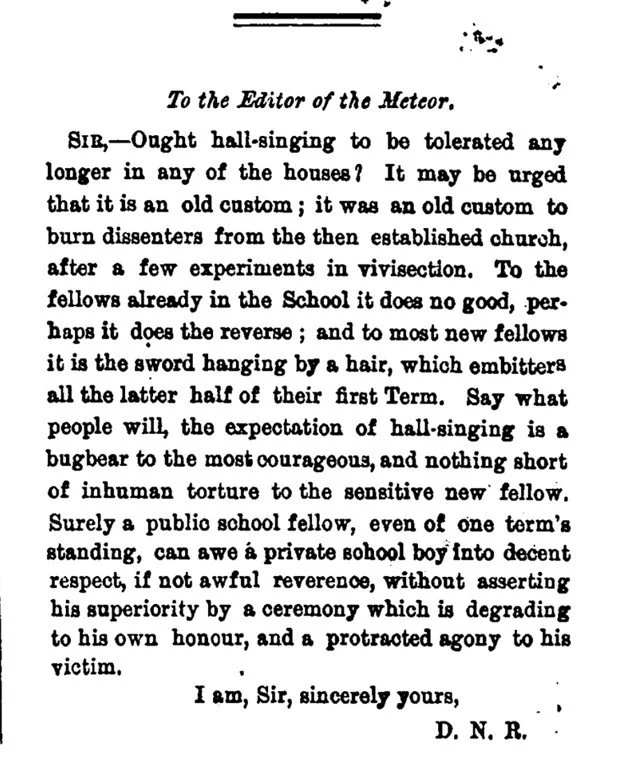
This test of endurance did receive criticism from some students, as exemplified in a correspondence to the editor of The Meteor published in 1874:
The Meteor, Vol. 86, 1874
Nonetheless, the majority of Rugbeians accepted the custom as a rite of passage. Even when such events were terrifying and even traumatic, boys not only participated but, when their time came, encouraged the next generation of boys to do the same.
In addition to demonstrating their willingness to subscribe to the established hierarchy, by participating in the ritual, newcomers exhibited their own inner endurance and bravery. More than simply a display of vocal skill, these short yet significant performances can subsequently be seen as a display of the boy’s own emerging ‘manliness’.
Depictions of ‘Manliness’ in School Boy Repertoire
Students’ absorption of public school ‘manliness’ was not only highlighted in boys’ implementation of singing, but also in the songs they selected and sang. Although, like any aural tradition, it is difficult to establish a comprehensive list of the songs adopted for hall-singing, Hughes’ fictional depiction of the tradition in Tom Brown’s School-Days, as well as various surviving accounts from former schoolboys, offer useful insight into the kinds of songs most frequently sung. While songs were likely selected for practical reasons such as their simplicity and general popularity, themes of strength, bravery, and duty ring out across the repertoires selected by students, which largely comprised sea songs and popular ballads.
While sea songs frequently recited romantic narratives of brave men at sea (such as “A Wet Sheet and a Flowing Sea”, tales of duty were most often celebrated through marching songs ( “The British Grenadiers” and “The Men of Harlech”), ballads referencing historic victories of the British army (“The Siege of Seringapatam” and “The Chesapeake and Shannon”) and other ‘old favourites’ associated with British regiments. Through their confident and energetic assertion of such songs, boys presented themselves as the proud Rugbeians they were expected to be:
For we can wrestle and fight, my boys, and jump o'er anywhere.
Oh, 'tis my delight on a shining night, in the season of the year
Lyrics from “The Lincolnshire Poacher”, described as an “old Rugby favourite” (Melly, pp. 114-115)
By engaging with these narratives and their depictions of strength, valour and athleticism, schoolboys could be transformed into the manly heroes described. Such stories of dutiful men could be easily related to students’ relationships with their house, where responsibility and honour were regularly fostered through inter-house competitions. A boy’s singing of ‘manly’ soldiers and sailors also communicated their embodiment of these prescribed ideals of masculinity to their peers. As explained by Geoffrey Drage in 1890:
“English boys admire one who is brave. But it is physical courage which chiefly evokes their admiration. They hold that a young Englishman should do his duty gallantly, however unwelcome it may be, should bear pain unflinchingly, should volunteer for difficult and dangerous service, and should face the hardships of life with a smile" (Drage, as quoted by Griffiths, p. 60).
Schoolboys certainly faced songs of battles and bravery with a smile. Hall-singing was typically a lively and spirited environment, complete with rowdy (drunk) boys standing on tables and sometimes interspersed with athletic games. In addition to highlighting the ‘aura of heroism’ which rose in prominence in the latter half of the century, songs like “Billy Taylor” exemplify how this romanticisation of bravery could sometimes result in the trivialisation of violence. Sung from the point of view of a sailor’s jilted bride, the ballad describes his infidelity, ending with him being fatally shot.
Forthwith she call’d for Sword and Pistol,
Which did come at her command,
And she shot her Billy Taylor,
With his fair one in his hand
Lyrics from ““A true and lamentable ballad call’d Billy Taylor, shewing the fatal effects of Inconstancy” (Published Sept. 24, 1804, Laurie & Whittle, 53, Fleet Street, London) as referenced in Hughes, p. 136.
Such narratives exemplify how boys not only engaged in an idealised view of bravery and duty, but, in some cases, became desensitised to the more aggressive and violent realities of military or sailor life. As P.J. Rich outlines, while school rituals like hall-singing may initially appear insignificant or trivial, “they were fundamental in preparing boys for imperial responsibility” (Rich, p. 25). Moreover, like so much else in public school culture, this romantic image of military life was distinctly British. While all songs would have been sung and heard with the British military in mind, several songs popular among students exhibited strong British (and particularly English) patriotic sentiments. As Percy C. Puck asserted in the introduction to his Oxford Songbook, schoolboys were “almost invariably appreciative of national melodies” (Buck, p. III). Even when singing repertoire without patriotic sentiments, loyalty to school and country was never far from the minds of students. Like most activities in the public school, “the proceedings wound up in a ‘loyal fashion’ with ‘God Save the Queen’”(Melly, pp. 114-115).
Imperial Considerations – Sounding ‘Imperial Manliness’
As the nineteenth century progressed, cultural nationalism and British patriotism became “increasingly characterised by a belief in the morality of imperialism” (Mangan, p. 128). Themes of destiny, duty, and service became closely intertwined with imperial ideology, a creed which, by the middle of the century, had also begun to incorporate militaristic overtones. Public Schools’ promotion of these ideals, combined with British patriotism and new militarism, formed an ideal of ‘imperial manliness’ which prepared the public schoolboy for his role within the Empire (Nash, p. 18). Discussing the impact of English public education in 1906, James Welldon (master of Dulwich College) described the dominance of the public school in the creation of leaders across the colonies:
“[The British Empire] has yet been singularly successful in producing administrators of high character and capacity; and that most of them, or many, have traced the secret of their lives to the lessons which they learnt, or perhaps more truly to the spirit which they acquired, when they were still young, in the schools and colleges of Great Britain." (Welldon, as quoted in Griffith, p. 54).
Like the many other games and inter-house traditions of public-school life, hall-singing reflected and reinforced the shaping of boys not only into ‘real men’ but into loyal imperial leaders. In addition to asserting school or house pride, songs celebrating masculine bravery and military service allowed boys to imagine themselves as the “imperial heroes” (Mangan, p. 33). For many, the tradition of hall-singing was not only an influential breeding ground for imperial thought but also connected those working in the colonies with their public school origins. Discussing an alumni dinner for Old Rugbeians in Calcutta in 1897, a correspondent for The Meteor reported how singing took place after the meal, lasting “till midnight when the meeting broke up" (The Meteor, Vol 361, 1897). Such instances not only highlight the continued function of hall-singing culture in solidifying public school identity but also demonstrate the deep-rooted cultural connection between public schools and the British colonial project.
Towards a Conclusion
By the middle of the century, more formal engagement with music-making had begun to be introduced into public school life. John Farmer’s implementation of formal ‘House Singing’ at Harrow was quickly adopted by other public schools, including Rugby. Colloquially known as ‘House Shout’, the practice not only utilised a similar repertoire in its early years but also incorporated much of the character of hall-singing, complete with a new boy solo to an audience which now included teaching staff:
“Farmer once said to a boy who timidly asked if he was out of tune - "Out of tune! - I couldn't get you on a single note - you were singing between the cracks!" (Ivimey, as quoted in Rainbow, p. 275).
While this practice gradually grew into a competition of musicality and vocal quality, the continued use of the term ‘shout’ hints at its origins in the earlier hall-singing tradition. Although the repertoire performed at these events gradually moved towards a more advanced art music repertoire, the prominence of marching songs and popular ballads continued at Rugby through their adoption by the school’s rifle corps after its establishment in 1860. Through the singing of songs and the playing of band music, students at Rugby communicated their school pride, their British patriotism and their position within the Empire, solidifying the ideas around ‘masculine’ identity highlighted in the hall-singing tradition. (You can read more about the music identity of Rugby’s rifle corps here.)
While the dominance ideals surrounding masculinity and imperialism within public school culture have been well established, the presence of themes of duty, leadership, patriotism and manliness within student-led music practice demonstrates how such ideas were absorbed and performed by school boys themselves. An examination of the repertoire and rituals of these unsupervised musical events, highlights how students not only understood the expectations placed on them but actually reinforced these expectations on each other. Through their performance as a nervous new boy, an aggressive audience member, or simply through their boisterous group singing, schoolboys exemplified their absorption and acceptance of their roles assigned by their school rank, their class position, and their gender. In this light, hall-singing can be understood as a site where boys performed their duty, not only as good schoolboys, but as ‘ideal men’ and eventually, imperial leaders.
Bibliography
Bloxam, Mathew Holbeche. Personal Reminiscences of Rugby School as It Was in 1813, Seventy Years Ago. 1883.
Buck, Percy C., The Oxford Songbook (Oxford University Press, 1921).
Ellis, Heather. ‘Thomas Arnold, Christian Manliness and the Problem of Boyhood’. Journal of Victorian Culture 19, no. 4 (2014): 425–41.
Hamlett, Jane. ‘“Rotten Effeminate Stuff”: Patriarchy, Domesticity, and Home in Victorian and Edwardian English Public Schools’. The Journal of British Studies 58, no. 1 (2019): 79–108.
Huggins, M. J. W,. The Making of an English Public School. Hiroona, 1982.
Hughes, Thomas Tom Brown’s School-Days, by an Old Boy. Edited, with a Preface, by H. C. Bradby, B.A. With Illustrations in Color and Pen and Ink Sketches by High Thomson. LeRoy Phillips, 1920. Internet Archive. https://archive.org/details/tombrownsschoold00hugh/page/n5/mode/2up.
Griffiths, John. ‘Eton and the Empire’. In Empire and Popular Culture, Routledge, 2021.
Griffiths, John. ‘The Training of an English Gentleman in the Public Schools 1’. In Empire and Popular Culture, Routledge, 2021.
Mangan, J. A., ‘“Muscular, Militaristic and Manly”: The British Middle-Class Hero as Moral Messenger’, The International Journal of the History of Sport 13, no. 1 (2007).
Melly, George. School Experiences of a Fag at a Private and Public School. Smith, Elder, and Co., 1854.
Nash, Paul. ‘Training an Elite: The Prefect-Fagging System in the English Public School’. History of Education Quarterly 1, no. 1 (1961): 14–21.
Neddam, Fabrice. ‘Constructing Masculinities under Thomas Arnold of Rugby (1828–1842): Gender, Educational Policy and School Life in an early‐Victorian Public School’. Gender and Education 16, no. 3 (2004): 303-326.
Rainbow, Bernarr. Music and the English Public School. Boethius, 1990.
Rouse, W. H. D. A History of Rugby School. Duckworth, 1898.
Tozer, Malcolm, “From Prussia with Love: Music at Uppingham School, 1853-1908”, Journal of Historical Research in Music Education, vol. 41, no. 2 (2018)
Wakeford, John, The Cloistered Élite : A Sociological Analysis of the English Public Boarding School. Macmillan, 1969.